For over twenty years, ball pythons have been part of my life — not just as animals in my care, but as constant companions and spiritual coworkers. They are more than family to me.
Like most keepers, I housed them separately. Why? Because that’s what we were all taught. The standard message echoed through forums and Facebook groups was clear: Do not cohabitate ball pythons. We were told that keeping them together would inevitably cause stress, aggression, competition, and illness. Solitary by nature. End of discussion.
But emerging research is beginning to challenge that long-held belief.
New studies suggest that ball pythons — particularly females and juveniles — may be more socially tolerant than previously assumed. In fact, research indicates that juvenile ball pythons may voluntarily cluster together, spending over 60% of their time in physical contact with one another (Skinner, M., Kumpan, T. & Miller, N., 2024). This behavior suggests that, under certain conditions, they may not be as strictly solitary as the reptile community has long maintained.
Now, first let me preface this by saying that I do continue to house my ball pythons separately. I use a rack system because, in my experience, it provides the most consistent control of heat and humidity — two of the most critical factors in proper ball python husbandry.
That said, separation does not mean isolation. All my snakes receive outside time, enrichment, and what I lovingly call “family time.” They are handled, observed, and engaged regularly. My approach has always been rooted in both practical care and deep respect for their well-being.
And yes. I have seen the infamous image of the ball python ingesting another after being together for an exorbitant amount of time. That situation was not based on housing two pythons together in a large tank. That situation was completely different.
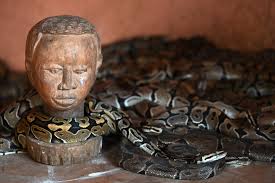
Benin, Africa
However, during my research, I was unable to find a single peer-reviewed study explicitly stating that housing ball pythons together is inherently dangerous. Instead, I was repeatedly directed to an article written by Thomas of NW Reptiles. In that piece, several references were provided regarding the physiological effects of stress — but those studies were conducted on humans. The justification given was essentially, “the studies were done on humans, but the findings apply to all animals.”
That is a broad and problematic leap.
Reptiles and mammals have fundamentally different physiological systems, stress responses, and social behaviors. While cross-species comparisons can sometimes offer insight, if research on human stress automatically applies to reptiles — without reptile-specific data — is scientifically unsound. Citing mammalian studies as definitive proof of reptile outcomes oversimplifies biology and does not constitute direct evidence.
Aside from that, the only other scholarly source I was able to locate was a 2021 study titled “Animal-appropriate housing of ball pythons – Behavior-based evaluation of two types of housing systems” (Hollandt, T., Baur, M., & Wöhr, A. C., 2021). However, this study did not address cohabitation at all. Instead, it focused specifically on comparing rack systems versus terrarium housing to evaluate which environment better supported species-appropriate behaviors.
In other words, the research centered on enclosure type — not on whether ball pythons should or should not be housed together.
As with all husbandry practices, nuance matters. But it’s fascinating — and humbling — to realize that even after decades of keeping and working with these sacred beings, we are still learning who they truly are.
And who they truly are may not be exactly what we’ve long assumed — or what we were taught to believe.
Science is not meant to reinforce dogma; it is meant to evolve our understanding. It challenges us to reexamine assumptions and refine our perspectives as new information emerges. Perhaps our long-held view of the ball python as strictly solitary deserves closer scrutiny. It may be that our collective understanding has been shaped more by repetition than by evidence — and that it’s time to look again, with curiosity rather than certainty.
The first was published on May 8, 2024: “Socially-mediated activation in the snake and social-decision-making network,” in Behavioral Brain Research. This study found that when female ball pythons were placed together in an enclosure with separate hiding spots, they did not simply remain isolated. Instead, they actively sought one another out, using scent cues to initiate social contact. Their interactions appeared to be intentional rather than incidental.
This research was followed in November 2024 by a study titled “Intense Sociability in a ‘Non-Social’ Snake,” conducted by Morgan Skinner. In this experiment, Skinner and his colleagues placed six ball pythons into a spacious enclosure for ten days, providing ample individual shelters for each snake.
Twice each night, researchers cleaned the enclosure and rotated the snakes into different hides. It was during one of these routine shelter changes that Skinner observed what he later described as a “python cuddle” — multiple snakes voluntarily choosing to rest in physical contact, even when given the option to remain separate.
Curious whether the clustering behavior was simply about the shelter itself rather than social preference, the researchers removed the shared hide. The result? The pythons regrouped and congregated under a different shelter. Their behavior suggested that it wasn’t the structure they were attached to — it was each other.
To further strengthen the credibility of the findings, Vladimir Dinets, a specialist in reptile social behavior, reviewed the study and reportedly could not identify any methodological flaws. His assessment added significant weight to the research, reinforcing the idea that these observations were not incidental, but indicative of genuine social tendencies.
Together, these findings challenge the long-standing assumption that ball pythons are strictly solitary, suggesting that under the right conditions, they may display a level of sociability previously unrecognized.
In conclusion, will I continue to house my ball pythons separately? Yes — at least until someone can convincingly demonstrate that tanks provide better overall environmental stability than the rack systems I currently use.
However, with this emerging research in mind, I can’t help but wonder: is it really so far-fetched to consider that ball pythons might benefit from occasional, carefully supervised social interaction? If studies are showing that certain females and juveniles actively seek one another out, perhaps the conversation isn’t about abandoning responsible husbandry — but about remaining open to the possibility that these snakes may be more socially nuanced than we once believed.
Maybe it’s not about rewriting everything we know overnight. Maybe it’s simply about allowing room for the idea that even a “solitary” snake might enjoy a play date now and then.
References:
Skinner, M., Kumpan, T. & Miller, N. Intense sociability in a “non-social” snake (Python regius). Behav Ecol Sociobiol 78, 113 (2024). https://doi.org/10.1007/s00265-024-03535-7
Skinner, M., Kumpan, T. & Miller, N. Intense sociability in a “non-social” snake (Python regius). Behav Ecol Sociobiol 78, 113 (2024). https://doi.org/10.1007/s00265-024-03535-7
Morgan Skinner, Dania Daanish, Chelsey C. Damphousse, Randolph W. Krohmer, Paul E. Mallet, Bruce E. McKay, Noam Miller Socially-mediated activation in the snake social-decision-making network, Behavioural Brain Research,Volume 465, 2024, 114965,ISSN 0166-4328,https://doi.org/10.1016/j.bbr.2024.114965.
Hollandt T, Baur M, Wöhr AC. Animal-appropriate housing of ball pythons (Python regius)-Behavior-based evaluation of two types of housing systems. PLoS One. 2021 May 27;16(5):e0247082. doi: 10.1371/journal.pone.0247082. PMID: 34043634; PMCID: PMC8158952.
https://www.nwreptiles.com/myths-about-ball-pythons/

 Cauldrons & Crossroads